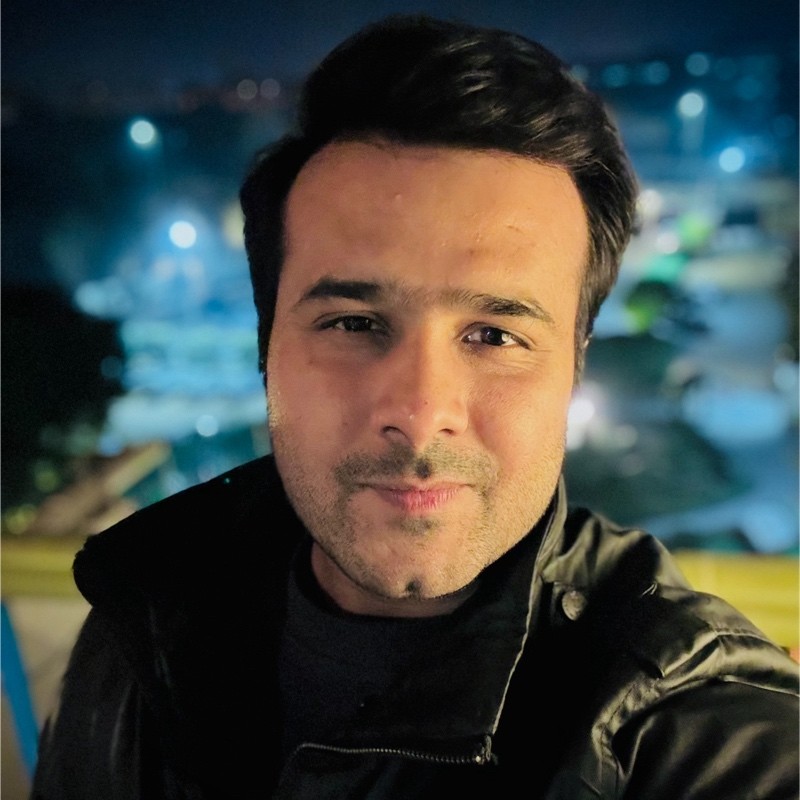
Mamoor Ali Khan
Ten years of empirical field research, from Peshawar to Notre Dame. A Research Operations Specialist with a record of directing multi-country studies spanning Argentina, Bangladesh, India, Kenya, Lebanon, Pakistan, and the United States.
Core expertise spans panel data construction, OLS-based analysis, and end-to-end field operations management. In parallel, I develop AI methods for academic research: inventing structured, command-driven workflows that improve research work cycles and establish reliable, reproducible practices for empirical teams.
The career began in 2013. A background in Computer Science led not to a technology firm but to a role within a pharmaceutical company, where working across structured data and business functions made the professional direction clear: applied quantitative analysis.
That early analytical work advanced into a product management position, where data-driven methods informed marketing strategy for OTC pharmaceutical products. A deliberate decision to pursue a Master's in Development Studies followed, connecting a technical foundation in programming and statistical methods to the field of development research and policy.
Field engagements with USAID and UNHCR projects provided the operational grounding. Collaboration with Dr. Luke Sonnet proved formative: his standards for analytical rigor shaped an approach to research operations built on precision, reproducibility, and disciplined data management. The technical work that followed established a track record in panel data construction and OLS-based analysis across complex, multi-country research environments.
From Peshawar to Notre Dame. The current role is Research Manager at the Kellogg Institute, University of Notre Dame. The distance traveled, professionally and geographically, reflects ten years of rigorous training, consistent execution, and the sustained engagement of exceptional mentors.
Dr. Miriam Golden
Dr. Golden extended trust and responsibility at a formative stage, assigning leadership roles on consequential international research projects. Her confidence in my capabilities, sustained across many years, has been foundational to this career. The standards she holds for rigor, precision, and intellectual honesty have shaped every dimension of this work.
Dr. Saad Gulzar
Dr. Gulzar expanded the scope of this work in ways that proved decisive. He offered repeated opportunities across his research portfolio and facilitated introductions to scholars at Stanford, Yale, and Princeton. The methodological exposure and professional network that followed have been central to this career's trajectory.
OCT 2025
PRESENT
Research Manager
Kellogg Institute, Notre Dame
PRESENT
MAY 2023
SEPT 2025
Senior Associate
Princeton University (Based in Pakistan)
SEPT 2025
JUN 2022
APR 2023
Lead Research Manager
Yale University (Based in Pakistan)
APR 2023
OCT 2018
MAY 2022
Project Manager
European University Institute (Based in Pakistan)
MAY 2022
APR 2016
OCT 2018
Program Consultant
USPCASE | USAID
OCT 2018
JAN 2014
JUN 2015
Assistant Product Manager
Libra Private Limited
JUN 2015
Note on the studies that follow: The entries below document nearly a decade of technical execution and operational leadership. On these studies, principal investigators hold authorship; the contribution in each case was as lead technical executor: rigorous data cleaning, statistical analysis in R, and the coordination of complex field operations and institutional relationships.
The work centers on a specific problem: making AI a reliable operational partner in academic research, rather than a general-purpose tool. This involves active exploration of how AI efficiency methods can improve research work cycles, and the systematic invention of structured, command-driven workflows that encode best practices for empirical social science. The underlying premise is that AI performs best when given precise, bounded instructions tied to clear professional standards.
The method is the Claude Skill: a personalized, markdown-based command that instructs Claude Code to execute a specific research task through defined phases with user approval checkpoints. Each skill encodes the operational logic of a research job (data integrity constraints, file structure conventions, documentation requirements) so that the task runs cleanly and reproducibly every time. The resulting skills are published as open-source GitHub repositories, available to any research team.
AI as a structured partner, not a probabilistic shortcut. Every workflow produces the same output under the same inputs.
Commands are personalized and task-specific. General prompts are replaced by skills that encode professional standards directly.
Every skill is open-sourced and documented so that any research team can adopt, audit, and build on the method.
super-RA
A research-assistant system for empirical social science, governed by a central brain: a constitution that installs into a project, supersedes the operator's default rules, and holds every skill to one standard: read freely, act only on explicit approval, and never state a source without a link that actually resolves. Each skill enforces data integrity, transparent variable tracking, and end-to-end reproducibility. Designed for researchers working with foundations, multilateral institutions, and policy organizations.
github.com/Mamooralikhan/super-RAConstructs a complete, self-contained replication package from an existing research project. Produces standardized file paths, cleaned datasets, and comprehensive documentation aligned with journal and funder requirements.
Audits every reference in a paper through a three-tier agentic workflow: an Assistant fetches each source, an independent Associate re-clicks every link, and a PI tier rules on author order and currency. Independence between tiers is the anti-hallucination mechanism: no agent grades its own work. Each citation is rendered through the paper's own .bst, and the run produces two HTML audit reports from a single verified source.
Standardizes analysis code for reproducibility across R and Stata workflows.
Synthesizes targeted literature reviews structured around specific research questions.
Generates structured academic referee reports following journal standards.
punjab-pp-boundaries
No open vector boundaries existed for Punjab's 297 Provincial Assembly constituencies under the 2018 delimitation; the ECP released them only as raster map panels and Form-7 text. This project reconstructs a 2018 layer through a fully reproducible Python pipeline, pairing a clean 2013 shapefile baseline with 30,679 GPS polling-station records. It separates two distinct inferences (renumbering all 297 seats, and updating the boundaries of the 165 seats in changed districts) and records the reliability of each on every feature. Version 2 followed an independent review that corrected v1's label errors and pared back its overstated claims.
Output: punjab_pp_2018.gpkg · EPSG:4326 · 297 features · CC BY 4.0 (data), MIT (code)
github.com/Mamooralikhan/punjab-pp-boundariesParses the 297 ECP constituency pages for the official 2018 codes (PP-1 to PP-297). Classifies Punjab's 36 districts as stable or changed by seat-count shift; 18 changed.
Point-in-polygon joins every GPS polling station to the 2013 polygons, then solves each district's 2018-to-2013 code assignment with the Hungarian algorithm, maximising stations matched. This replaced v1's centroid-distance matching, which had permuted labels in several stable districts.
Carries the 2013 polygon for the 132 stable-district seats. For changed districts, it builds Voronoi cells from polling-station points for the 106 seats with GPS coverage (positional error roughly 200 to 1,000 m), and marks the remaining 59 as flagged 2013 placeholders, not administrative lines.
Merges the geometry sources into one GeoPackage and runs validation checks that fail the run on error. Every feature carries a reliability label: source, assignment_method, gps_validated, and overlap_pct.
Verifies the 48 weakest code assignments by hand against the ECP Form-7 document; three were corrected (manual_form7). The raw ECP inputs are read-only throughout and never rewritten.
Research-assistant system for empirical social science, governed by a central brain. Enforces data integrity, reproducibility, and transparent variable tracking, with agentic reference verification.
Reconstructs all 297 Punjab PA constituency boundaries from archival ECP maps and 30,679 GPS polling station coordinates. Five-step Python pipeline using Voronoi tessellation, Hungarian algorithm matching, and TPS image warping.
Mentor
Career Services Office (CSO), LUMSAdvises students at the Lahore University of Management Sciences on careers in development research, field operations, and policy institutions. Draws on direct experience across academic, multilateral, and government-affiliated research environments.
Data and Research Analyst
Consortium for Development Policy Research (CDPR)Conducts policy research and quantitative data analysis in support of evidence-based policy work in Pakistan, with a focus on governance, public finance, and development outcomes.
Senior Research Associate
Center for Economic Research in Pakistan (CERP)Managed large-scale research projects across multiple simultaneous engagements, coordinated field teams, and maintained data quality standards for economic and policy research initiatives in Pakistan.
Research Associate
Stanford UniversityProvided research and data support for projects led by Dr. Saad Gulzar, contributing to political economy research in Pakistan with a focus on legislative behavior and public service delivery.